
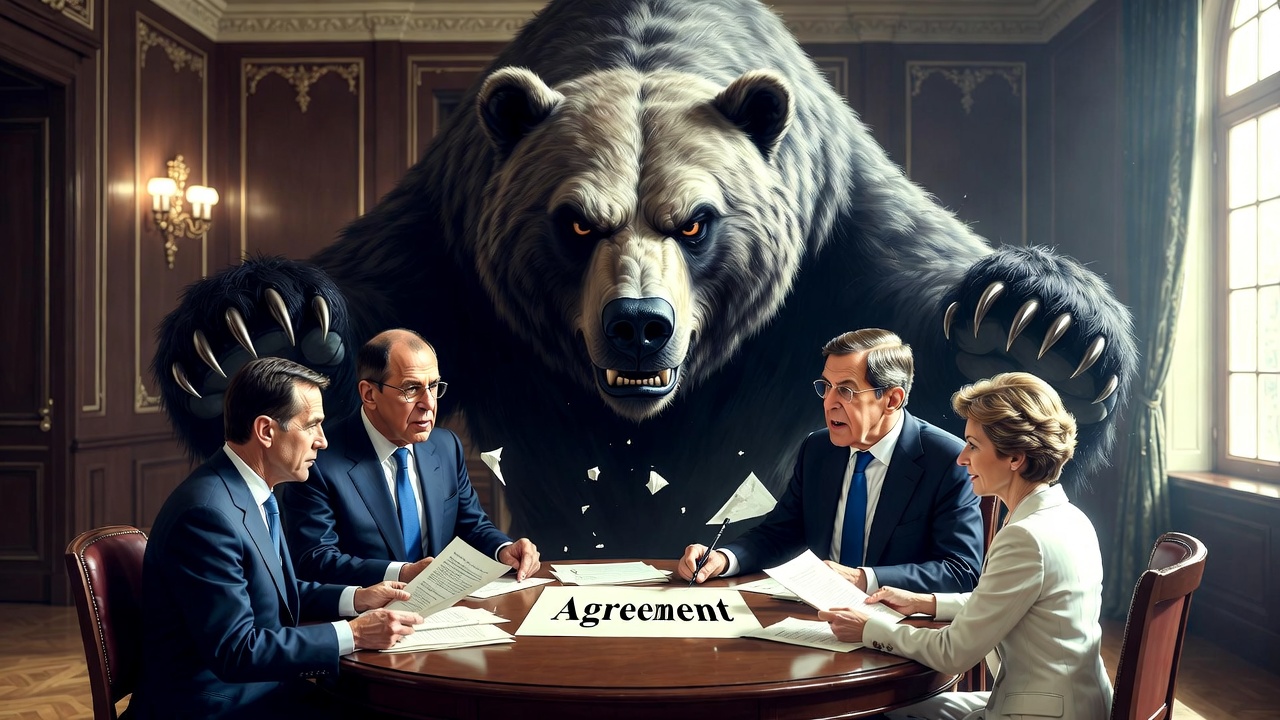
Let’s start with reality. On April 17, a meeting took place in Geneva, the goal of which was to sign an agreement to de-escalate the tension regarding the Ukrainian issue. It seemed to happen, and the parties signed the treaty. A series of actions were developed to relieve the tension and change the situation.
And everything would have been fine, if the key party had genuinely been ready to fulfill the agreement.
But what happens next?
Next, the aggressor declares that everything happening in Kyiv is wrong, and that is exactly where buildings must be vacated and people disarmed. That the Ukrainian government is to blame for everything, while in the east of the country, things are just happening naturally, and detainees simply need to be released. And generally, that Ukraine is structured incorrectly, and its Constitution needs to be “tweaked.” Regarding this last remark, only one question arises:
— Whom are we “tweaking” it for?
Here is where we can move on to the myths.
Myth One — You can negotiate with an aggressor.
This is a very common myth or illusion that confuses many, including the EU and the US. Let’s look at the situation abstractly.
A massive bear, crazed with fear, climbs into a house. Let’s not analyze what scared him right now. He simply climbed through the window and started making himself at home in the “room,” while the entire world watches as he establishes his own rules step by step and settles in.
Of course, they tell him he can’t do that, that he violated the 1994 agreement, that everything happening in the country is Ukraine’s business and it will sort it out itself. They tell him that sanctions will be imposed, his country’s economy will suffer, and there will be fewer “berries” in his territory. But none of this matters to him because he is a “bear,” he has his own goal, and he couldn’t care less about casualties or losses.
What does this indicate?
It indicates that the counterforce is inadequate, and it is perceived as weakness and appeasement. It means he can keep going.
Can you negotiate with someone who has already broken a treaty and knows perfectly well that he will face no consequences for it?
Yet the world persistently invites the “bear” to the negotiating table and expects peaceful actions from him.
Myth Two — The aggressor might start acting in the interest of the other party (the victim).
It is a highly naive position to expect the “bear” to admit his actions are aggressive and unlawful, and to peacefully leave the territory where he already has one paw planted—especially while his bought-and-paid-for “hounds” are paving the way for him.
What is there to negotiate with the “bear”?
Find at least one example in history where an aggressor stopped without a compelling reason or put themselves in the “victim’s” shoes. The escalation of violence continues until an effective defense is built and a solid pushback is delivered.
So what forced Putin to sit down at the negotiating table?
The Anti-Terrorist Operation (ATO), which greatly hinders his ability to wage war using his chosen methods. After all, if you remove external forces from the game and cut off the financing of corrupt citizens, the ability to advance further along this path collapses.
By sitting down at the negotiating table, the aggressor bought time to suspend the ATO. Through this, he created an opportunity to redeploy forces and review his actions and options.
Everything the aggressor does is aimed at achieving his goal. By trusting the aggressor, relying on his mercy and prudence, we lose our strength and even indirectly assist him.
Myth Three — You can win a war by “playing catch-up.”
Any clash of interests can be viewed as a kind of war. As for this situation, it is a real war aimed at capturing specific territories, using minimal forces, and exploiting the enemy’s weaknesses.
Yes, the invader perfectly knows the vulnerabilities of his opponent and the weakness of the power structure. He acts methodically, modeling the situation and testing for the capacity to be decisive and give an adequate response. He moves slowly but confidently, remaining quite cautious.
What does this give Ukraine?
All the aggressor’s actions clearly highlight where and what isn’t working, as well as who is minded how, and whose side they are playing on. We haven’t had such a thorough reality check in a long time…
All that remains is to learn to act proactively, to start modeling the situation ourselves, and to act firmly and decisively to cut off all possibilities for the enemy to realize their plans. Only when the aggressor faces fierce resistance and determination, experiences the effectiveness of defensive measures, and suffers real economic and moral losses, will he be forced to seek common ground and a way out of the state of war.
This means that to negotiate anything with anyone, there must be an active desire from all parties; only then will agreements be honored.
Well, I suggest we stop harboring illusions and start acting proactively; this is entirely possible and realistic. You just need to accept reality and start playing your own game.
Draw the right conclusions, and when negotiating, realistically assess the balance of power.
Olena Boiko — a business coach who creates results
+38 099 23 850 33
